
Researching Captain Joseph Vos and the William Manson trial provided a valuable opportunity to explore the ways in which the Queensland-Pacific labour trade operated in the 1890s. By combining archival research into the labour recruiting voyages of the William Manson, and the subsequent kidnapping trial, with cultural history research into the broader public conversations surrounding the episode, I was able to reconstruct the ambiguities and complexities of a late-colonial scandal. Exploring the role that sound recording technology played in the public perception of Joseph Vos provides an opportunity to reflect on the ways in which sound and listening are important in understanding this transitional period in Queensland history.
As a Harry Gentle Visiting Fellow, I investigated a public scandal that rocked Queensland at the close of the nineteenth century. In 1895, the sea captain Joseph Vos and six other men of the labour recruiting ship William Manson faced trial in the Supreme Court. They were charged with kidnapping several people from Malaita, in the Solomon Islands, and forcibly bringing them to Queensland to work as indentured labourers in the sugar industry. The William Manson trial was the last major labour recruiting scandal of the nineteenth century.[1] While ‘irregularities’ and ‘outrages’ (colonial euphemisms: violence, deception, exploitation) were ever-present in the labour trade, a public reckoning of this scale had not been seen in Queensland for a decade.
Ultimately, a jury acquitted the defendants of the first count of kidnapping, and the Crown withdrew the remaining two charges.[2] Joseph Vos and his colleagues walked free. But they were not exactly untarnished from the episode. The men of the William Manson — the master, Joseph Vos; the Government Agent, George Olver; and five more crewmembers — were debarred from ever again participating in the Pacific labour trade.[3] The William Manson affair galvanised public opinion and acted as a microcosm of the wider debates that had been raging around the system of indentured Pacific Island labour that had been in operation in Queensland for the past thirty years.
This disturbing episode took place in the final decade of the Pacific indentured labour trade, a system that defined Queensland’s economy, society and culture in the second half of the nineteenth century. Between 1863 and 1904, around eight hundred voyages departed from Queensland ports to recruit labourers to work in the Queensland sugar industry.[4] Recruiting ships visited more than eighty-five island groups in the Western Pacific, and over sixty thousand indentured labour contracts were signed over the forty years of the labour trade’s operation, representing over fifty thousand South Sea Islanders who came to Queensland.[5] The majority of recruits came from the New Hebrides (Vanuatu) and the Solomon Islands.[6] The labour trade was always controversial and hotly debated in Queensland, the Pacific and in Britain, and it was punctuated by frequent scandals, violence, exposés and inquiries.
I was drawn to one aspect of Joseph Vos and his career that has not yet received detailed treatment: contemporary accounts reported that Vos had a phonograph with him on board the William Manson. This was a time when global sound recording technology was in its infancy in Australia: full-scale commercialisation of the ‘talking machine’ had not yet commenced, and in the early 1890s there was only a mere handful of such recording devices in the Australian colonies. Joseph Vos was an early adopter of a revolutionary new technology. The phonograph was part of a host of techniques by which Vos sought to portray his recruiting voyage as modern, up-to-date, respectable, at a time when most labour recruiting ships were notoriously old, shoddy and dangerous.[7] It also added a theatrical flair to the public reception of the William Manson and its rakish captain: between voyages, Vos opened a ‘phonograph parlour’ on Queen Street, where he publicly exhibited recordings which he reportedly made on Queensland plantations and in the Solomon Islands.[8] The story of Vos and his phonograph circulated for years afterwards, in the colonial press as well as in the emerging trade literature of the global sound recording industry.
I wanted to look more closely at the role of Joseph Vos’s phonograph in the William Manson scandal. I wanted to ask: what can we learn about the Queensland labour trade if we place the phonograph at the centre of the story?
What I found was that the gulf between myth and reality was wide: the phonograph did not feature heavily in the recruiting activities of Joseph Vos aboard the William Manson, nor in the subsequent legal proceedings. This was hardly a surprise: by the 1890s, labour recruiting ships were a familiar presence on Malaita; Malaitans would not be duped by technological trickery.[9] Rather, the story of kidnapping which unfolded was of a less sophisticated and more brutal character: Vos allegedly conspired with Kwaisulia — a powerful passage master based at Adagege in the Lau Lagoon region — to seize ‘recruits’ for the William Manson by force.[10]
Yet the phonograph still offers an important perspective on the William Manson trials. The ‘talking machine’ was important as a cultural phenomenon, as a catalyst for a heady brew of expectations and ideas regarding speech, listening and power that circulated throughout colonial society in the 1890s and subsequently. Ultimately, sound recording may not explain Joseph Vos and the William Manson episode, but attending to the acoustic world of the labour trade can add necessary sensory texture to our understanding of late nineteenth-century Queensland.
[1] Tracey Banivanua-Mar, Violence and Colonial Dialogue: The Australian-Pacific Indentured Labor Trade (University of Hawai’i Press, 2007), 142.
[2] ‘William Manson Case. The Verdict Of The Jury. “Not Guilty.” The Prisoners Remanded On Other Charges,’ Courier (Brisbane), 23 March 1895, 6, https://trove.nla.gov.au/newspaper/article/3599142; ‘William Manson Case. Other Charges Of Kidnapping. The Crown Enters A Nolle Prosequi. The Prisoners Discharged,’ Courier (Brisbane), 26 March 1895, 6, https://trove.nla.gov.au/newspaper/article/3599218
[3] Letter, John O’Neill Brenan, Immigration Agent, Brisbane, to Principal Under Secretary, Brisbane, 26 March 1895, recommending that the Government Agent, officers and crew on the second voyage of the William Manson be debarred from the labour trade, Queensland State Archives, ITM847522, DR65703, Correspondence – inwards, letter 1895/3457. See handwritten minute from William Parry-Okeden, Principal Under Secretary.
[4] Clive Moore, Hardwork: Australian South Sea Islander Bibliography, with a Select Bibliography of the Sugar Industry and the Pacific Labour Trade (Australian South Sea Islanders (Port Jackson) Limited, 2019), 57, https://www.assipj.com.au/southsea/wp-content/uploads/FINAL-AUSTRALIAN-SOUTH-SEA-ISLANDER-BIBLIOGRAPHY-28-08-2019.pdf.
[5] Clive Moore, Sugaropolis: The Mackay-Pacific Islands People Trade Voyage Statistics, 1867–1903 (University of Queensland Press, 2020), 4.
[6] Nicholas Thomas, Islanders: The Pacific in the Age of Empire (Yale University Press, 2011), 240–41; Moore, Hardwork, 5.
[7] ‘Current News. By Telegraph and Otherwise,’ Queenslander (Brisbane), 12 August 1893, 332, https://trove.nla.gov.au/newspaper/article/20343914
[8] See, for example: ‘Phonograph Parlour. Opposite General Post Office,’ Courier (Brisbane), 5 April 1894, 2, https://trove.nla.gov.au/newspaper/article/3577318; ‘Phonograph Parlour,’ Telegraph (Brisbane), 5 April 1894, 5, https://trove.nla.gov.au/newspaper/article/172553175; ‘Captain Vos and the Phonograph,’ Telegraph (Brisbane), 7 April 1894, 5, https://trove.nla.gov.au/newspaper/article/172554166; ‘Amusements. The Phonograph Parlour,’ Courier (Brisbane), 9 April 1894, 6, https://trove.nla.gov.au/newspaper/article/3577528; ‘Phonograph Parlour,’ Telegraph (Brisbane), 9 April 1894, 6, https://trove.nla.gov.au/newspaper/article/172548661
[9] Clive Moore, Making Mala: Malaita in Solomon Islands, 1870s to 1930s (ANU Press, 2017), chap. 2.
[10] Clive Moore, “Peter Abu‘ofa and the Founding of the South Sea Evangelical Mission in the Solomon Islands, 1894–1904,” Journal of Pacific History 48, no. 1 (2013): 29–33.
 This project arose out of my 2019 PhD thesis, ‘Colonial Soundscapes: A Cultural History of Sound Recording in Australia, 1880–1930.’ My doctorate was about the first fifty-odd years of recorded sound in Australia. My method was to follow the ‘talking machine’ — as gramophones and phonographs were often described in their early years — as the technology of recorded sound spread across the country. I explored the ideas, experiences and meanings that adhered to sound recording in the late nineteenth and early twentieth centuries. In the 1880s and 1890s, the first phonographs in Australia were rare anomalies, spectacular ruptures in the fabric of everyday life. By the eve of the Great Depression, the gramophone industry had become a major national industry: it was estimated that over one million gramophones had been sold in Australia over the past generation.[1]
I found that when the technology of sound recording was still new, it provoked Australian listeners to think about sound itself — how sound worked, what sounds were important to them, what sound might be able to do, and how their wider worlds sounded. I found that this provided us with a unique opportunity to reflect on the wider soundscape of Australian life in the late nineteenth and early twentieth centuries, in all its complexity.[2]
[1] Henry Reese, “Colonial Soundscapes: A Cultural History of Sound Recording in Australia, 1880–1930” (PhD Thesis, University of Melbourne, 2019).
[2] Emily Thompson, The Soundscape of Modernity: Architectural Acoustics and the Culture of Listening in America, 1900–1933 (MIT Press, 2004), chap. 1.
The fellowship provided a valuable opportunity for me to get my hands dirty (quite literally) at the Queensland State Archives (QSA), following the archival traces of the William Manson’s Western Pacific recruiting voyages in 1893 and 1894, and their aftermath in the criminal justice system and beyond. By the 1890s, the labour trade generated enormous reams of paperwork: recruiting ships were licensed and overseen by the public servants in the Pacific Island Labour Branch, a sub-department of the Colonial Secretary’s Office. The Colonial Office in London insisted on inspecting the details of each voyage, so the paper trail led up to the Governor’s Office and thence to the Imperial authorities.
I came to this project as a relative newcomer to the hard graft of archival research into nineteenth-century Queensland history, and I thrilled at the chance to get my head around the top-numbering system of the Colonial Secretary’s inwards correspondence registers (QSA Series S11936), and enjoyed hunting down those original runs of correspondence which survived in the Colonial Secretary’s Inwards Correspondence (Series S5253). Tracing the progress of the William Manson matter through the government agencies of late nineteenth-century Queensland required considerable lateral thinking, and I located further correspondence relating to the William Manson, among other places, in the Governor’s Official Correspondence (S1139), the Chief Secretary’s Batch and Miscellaneous Subject Files (S5384), the Agent-General for Queensland’s despatches (S5321), and the despatches of the Secretary of State for the Colonies (S9188).
I found additional records — created as the William Manson case made its way through the criminal justice system — in the Inward Correspondence of the Department of Justice (S13336), the Crown Solicitor’s registers of Criminal Depositions (S6226), the Deposition and Minute Books of the Brisbane Police Court (S6300), and the notebooks of the Judges of the Supreme Court, Moreton Bay (S18554). In particular ITM95405 (contained in Series S15536 – Information, Depositions and Associated Papers in Criminal Cases Heard in Sittings in Brisbane) contains several depositions from the criminal trial.
I cross-referenced the information located at QSA against the records of the Colonial Office in London, which are held in the National Archives in Kew but made available to view digitally via the National Library of Australia (NLA) through the Australian Joint Copying Project (see the finding aid to the Colonial Secretary’s correspondence here). The National Archives series CO/234 covers original correspondence from the Governor of Queensland to the Secretary of State for the Colonies for the years 1859 to 1900: records CO 234/59, CO 234/60, CO 234/61 and CO 234/62 cover the years 1894 and 1895.
Despite the vast breadth of archival records generated by the labour trade, many aspects of the William Manson case remained mysterious — a potent reminder that only the barest fragment of historical business activity ends up surviving in the archives. Further, as the historian Tracey Banivanua-Mar has noted in her essential Violence and Colonial Dialogue, researching the history of the labour trade predominantly through the traces left in government records poses an epistemological challenge: we learn of the labour trade from the colonisers’ perspective, and recovering the historical experiences of South Sea Islander peoples in Queensland can be fraught and problematic at best.[1] It is not my place to speak for the experience of the Malaitan people whose lives were changed by the William Manson and its crew.
I supplemented the QSA materials with a hefty dose of reading among digitised colonial newspapers in Trove. This was especially important in understanding those public activities which unfolded beyond the realm of official documentation: situating Vos and his phonograph in the cultural milieu of 1890s Queensland required me to sift through the Brisbane and Sydney daily papers. The contemporary newspaper record was also integral in reconstructing the court proceedings facing Vos and his crewmates. The kidnapping charges were first heard at a committal hearing in the Central Police Court between 22 November 1894 and Friday 28 December 1894, at which point the accused were committed for trial in the Supreme Court from 3 March 1895.[2] The Supreme Court trial took place over twelve days between 11 March 1895 and 25 March 1895, before Judge George Rogers Harding. From the beginning, the case attracted huge public attention: daily reports of the legal proceedings unfolded before an avid reading public like a crime serial. A large crowd attended the court every day.[3] I have compiled the daily reports of the proceedings in Brisbane in a Trove list which readers are welcome to consult.
There is an especially rich and vibrant historical literature regarding the Queensland labour trade, and I soon realised that I had another PhD’s worth of reading ahead of me. The sensitivity of the topic necessitated that I complete a huge dose of contextual reading in order to fully grasp the nuances of the topic. This I completed in huge gulps of words, before and after my day job and on weekends. I followed many unexpected side quests: I learned about shipping registration and Lloyd’s Register; I learned about the shifting character of British and European imperialism in the Western Pacific through the Western Pacific High Commission; I learned about the Colonial Office and the competing political constituencies it addressed in its dealings with Queensland’s ever-controversial labour trade; I read about indentured labour in global context in the nineteenth century.
[1] Banivanua-Mar, Violence and Colonial Dialogue, 10.
[2] ‘Charge of Kidnapping. William Manson Case. Captain Vos in Brisbane. Mr. Pinnock Refuses Female Sureties,’ Telegraph (Brisbane), 23 November 1894, 2, https://trove.nla.gov.au/newspaper/article/171945893; ‘Alleged Kidnapping. The William Manson Trials. Committed for Trial,’ Telegraph (Brisbane), 29 December 1894, 4, https://trove.nla.gov.au/newspaper/article/171937484
[3] ‘Charge of Kidnapping. Barque William Manson. Police Court Yesterday. Mr. Pinnock Refuses Bail. Other Magistrates Grant Bail,’ Telegraph (Brisbane), 27 November 1894, 2, https://trove.nla.gov.au/newspaper/article/171943210
As with every research project, the detours and side quests are the most interesting part of the journey. As I read about the William Manson case, I became fascinated by the working of the bureaucracy that was established to regulate and oversee the Queensland labour trade. I was intrigued at the personal level on which the trade was conducted. The work of pursuing Joseph Vos and the William Manson was spearheaded by John O’Neill Brenan, Queensland Immigration Agent and Officer in Charge of the Pacific Island Labour Bureau. Brenan’s status as a public servant, tasked with seeing to the welfare of indentured Pacific Island labourers, enforcing colonial regulations of the recruiting process, investigating alleged ‘irregularities,’ and liaising with his superiors in the Colonial Office and in other departments, placed him in a uniquely influential position. Once he was alerted to the alleged kidnapping that took place off Malaita — it must not be forgotten that the William Manson trial is important because it was instigated by the actions of a Malaitan man Peter Abu‘Ofa, who reported Joseph Vos’ actions to a Queensland missionary — Brenan pursued Vos and the William Manson with especial alacrity.[1] There is something unstable and complicated about Brenan: he embodied a liberal outlook on the labour trade that was common in government circles of his time: he exuded a faith that good governance, well-enforced regulation, could render the labour trade free of ‘outrages,’ and ultimately respectable and accountable to the colonial and Imperial authorities.
And what of the phonograph? Ultimately, it played only a small part in the legal proceedings: under cross-examination in the Supreme Court on 18 March 1895, Joseph Vos claimed that the Malaitan passage-master Kwaisulia had only come aboard the William Manson to listen to the phonograph (and not, as was alleged, to make an agreement to help Vos kidnap recruits to bring to work in Queensland).[2] In Vos’ testimony, the phonograph becomes a key part of the social life and technological appeal of the William Manson, but does not play a central role in the ‘irregularities’ that were purported to occur off Malaita.
More broadly, attending to the role of recorded sound encourages us to understand the courtroom itself as a staging ground for performances of respectability, identity and personhood across cultural boundaries.
[1] Moore, “Peter Abu‘ofa and the Founding of the South Sea Evangelical Mission in the Solomon Islands, 1894–1904,” 24.
[2] ‘Supreme Court. Monday, March 18.’ Courier (Brisbane), 19 March 1895, 2, https://trove.nla.gov.au/newspaper/article/3598806
The William Manson encapsulates an ambiguous and transitional phase in Queensland history, alive with all the tensions of the day. This partly explains why the episode is so remarkable: it was an opportunity of rupture that served to reveal some of the underlying structures of colonial society in the 1890s. As Tracey Banivanua Mar has noted, the campaigns of individual humanitarians were usually ineffective in creating systemic change in the conditions faced by Pacific Islander labourers.[1] As the Manson case shows, the intention of ostensibly well-meaning figures such as John O’Neill Brenan was not necessarily to challenge, abolish or even expose the abuses of the trade as such, but to maintain the labour trade within the liberal framework of the rule of law. In this sense, my project fits into a tradition of historical writing that sees scandal as a culturally constructed phenomenon and thereby a way of examining the operation of the broader structures of a society in a particular historical context.[2]
As with the Hopeful case a decade earlier, the William Manson cases revealed a Queensland public that was unwilling to accept the conviction of white men on the basis of people of colour.[3] In his report to the Principal Under Secretary, Brenan framed the investigation with reference to a wider purpose: ‘I endeavoured by examination of the persons implicated, and other white evidence obtainable, to prove the truth of the charges and thus show that irregularities cannot take place on any labour vessel and escape discovery.’[4] Perhaps what is most striking about the trial is the fact that outrages were discovered, and made public, and discussed globally, but were ultimately not influential in affecting any broader change in the broader labour trade.
My experience as a Harry Gentle Visiting Fellow was incredibly rewarding, and I am incredibly grateful for the opportunity to explore this complicated and difficult topic. Special thanks are also due to the staff at QSA who made me feel so welcome as a researcher. I look forward to writing further on this topic in the future.
[1] Banivanua-Mar, Violence and Colonial Dialogue, 131.
[2] Callie Wilkinson, “Scandal and Secrecy in the History of the Nineteenth-Century British Empire,” The Historical Journal 65, no. 2 (2022): 548.
[3] Christopher, “The Saviour and the Revolutionary,” 333.
[4] Copy of letter, John O’Neill Brenan, Immigration Agent, Brisbane, to Principal Under Secretary, Brisbane, 13 November 1894, reporting on the second voyage of the William Manson, Queensland State Archives, ITM858509, Local official letters to the Governor, 3 July 1894 to 27 December 1894, pp.883
Please note: this is not intended to be a comprehensive list. Rather, I recommend these texts as starting points for readers interested in exploring the topic further, and as illustrations of the diversity and richness of the historiography.
Banivanua-Mar, Tracey. Violence and Colonial Dialogue: The Australian-Pacific Indentured Labor Trade. University of Hawai’i Press, 2007.
Brown, Laurence. “‘A Most Irregular Traffic’: The Oceanic Passages of the Melanesian Labor Trade.” In Many Middle Passages: Forced Migration and the Making of the Modern World, edited by Emma Christopher, Cassandra Pybus, and Marcus Rediker. University of California Press, 2007.
Christopher, Emma. “An Illegitimate Offspring: South Sea Islanders, Queensland Sugar, and the Heirs of the British Atlantic Slave Complex.” History Workshop Journal 90 (2020): 233–52.
Christopher, Emma. “Far More than Money: British West Indian Slavery, Emancipation, and Australia’s Sugar Industry.” Australian Historical Studies 52, no. 4 (2021): 491–508.
Corris, Peter. Passage, Port and Plantation: A History of Solomon Islands Labour Migration, 1870-1914. Melbourne University Press, 1973.
Davis, (Waskam) Emelda. “Children of the Sugar Slaves: Black and Resilient.” MA Thesis, University of Technology Sydney, 2020.
Moore, Clive. Kanaka: A History of Melanesian Mackay. Institute of Papua New Guinea Studies and University of Papua New Guinea Press, 1985.
Moore, Clive. Making Mala: Malaita in Solomon Islands, 1870s to 1930s. ANU Press, 2017.
Moore, Clive. “Peter Abu‘ofa and the Founding of the South Sea Evangelical Mission in the Solomon Islands, 1894–1904.” Journal of Pacific History 48, no. 1 (2013): 23–42.
Munro, Doug. “Review Article: Revisionism and Its Enemies: Debating the Queensland Labour Trade.” Journal of Pacific History 30, no. 2 (1995): 240–49. https://doi.org/10.1080/00223349508572798.
Saunders, Kay. Workers in Bondage: The Origins and Bases of Unfree Labour in Queensland 1824-1916. University of Queensland Press, 1982.
Scarr, Deryck. Fragments of Empire: A History of the Western Pacific High Commission, 1877–1914. ANU Press, 1967.
Shlomowitz, Ralph. “Markets for Indentured and Time-Expired Melanesian Labour in Queensland, 1863-1906: An Economic Analysis.” The Journal of Pacific History 16, no. 2 (1981): 70–91.
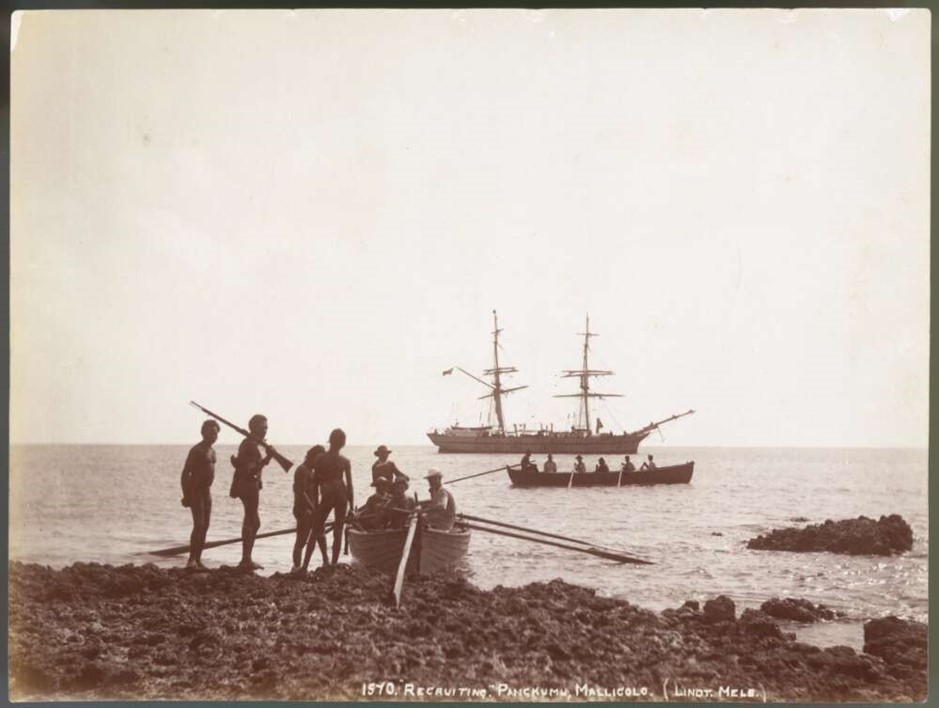
This photograph by J.W. Lindt represents a recruiting scene in the New Hebrides around 1890. It illustrates the intimate nature of labour recruiting, which was often conducted face-to-face, on the beach, even into the 1890s and 1900s. As the historian and anthropologist Nicholas Thomas has argued of the labour trade, despite the best efforts of the Queensland government to regulate the conditions on board recruiting ships and on sugar plantations, the moment of recruiting itself remained controversial, delicate, and bound up with the possibility of misunderstanding and disagreement: recruiting ‘engendered confrontation; it was inherently explosive (Nicholas Thomas, Islanders: The Pacific in the Age of Empire (Yale University Press, 2011), 230).’
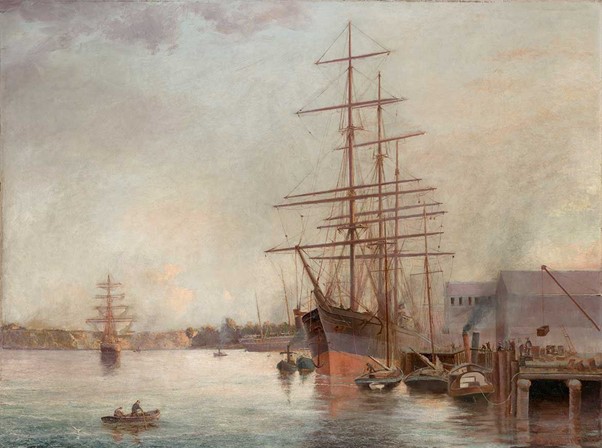
This painting captures the bustling nature of the Town Reach of the Brisbane River, off Eagle Street, in the 1890s. It was here that the Brisbane public came to admire the William Manson when it first came to Queensland in August 1893. Across the river at Kangaroo Point was the Immigration Depot, where the Immigration Agent, John O’Neill Brenan, oversaw the inspection of all South Sea Islander recruits who put in to Brisbane.
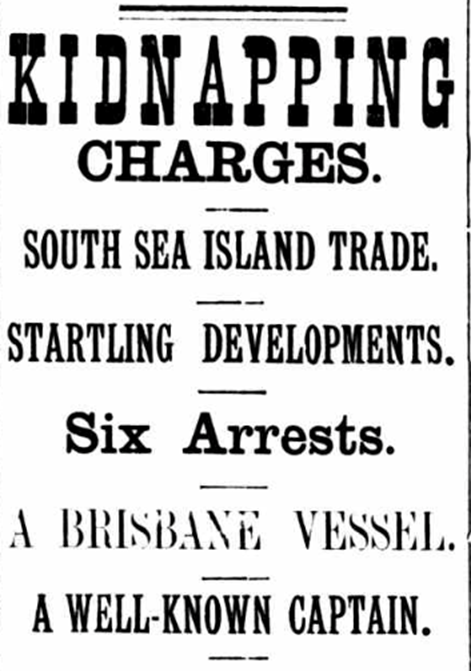
A typical headline from the William Manson case.
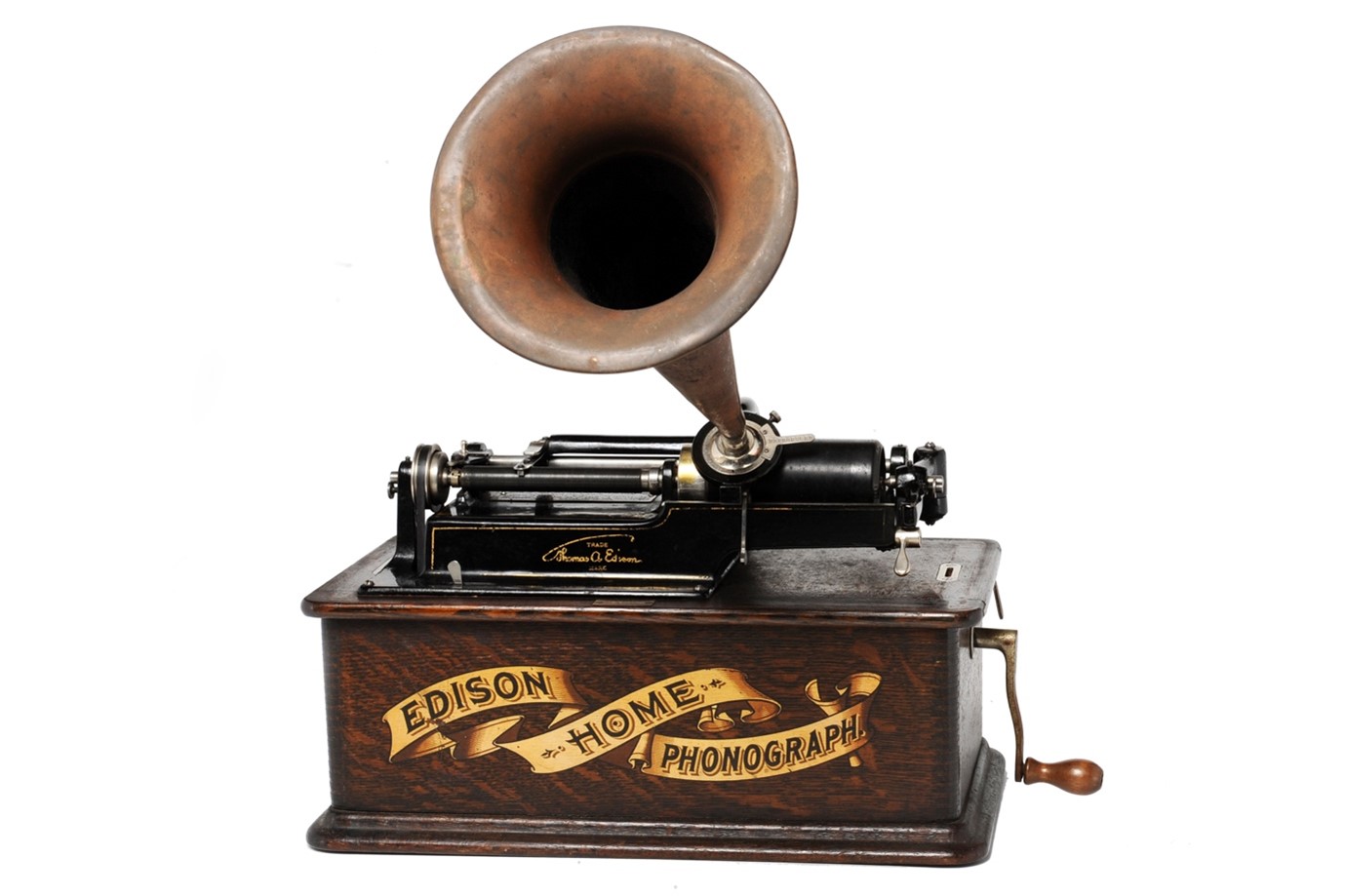
An early cylinder phonograph. Joseph Vos used a similar device on board the William Manson. Source: Edison Home Phonograph (c.1906).

