
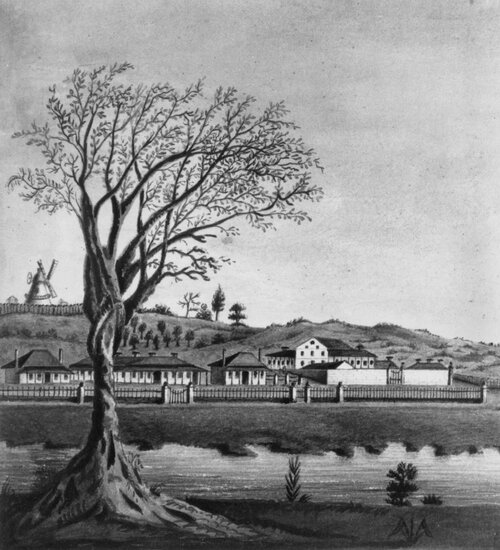
This research project was undertaken by researcher, filmmaker and Harry Gentle Resource Centre Visiting Research Fellow, Robert Braiden.
Drawing on research from the Queensland State Archives, historical records, and sites across southeast Queensland, Robert has explored one of the defining questions in Brisbane’s history: who decided to relocate the Moreton Bay penal settlement from Redcliffe to the Brisbane River?
This project examines why the settlement was originally established at Redcliffe, the challenges that led to its relocation less than a year later, and the reasons for selecting the area known to First Nations peoples as Meanjin and Binbilla. While many of the key figures in this story are well known, important questions remain about how the decision was made, who ultimately chose the new location, and whether that choice ever received formal approval.
Through archival evidence and historical investigation, Robert has shed new light on the decisions, personalities and enduring mysteries that shaped the beginnings of Brisbane.

Image courtesy of Robert Braiden.
About the researcher
Robert Braiden is a filmmaker, local history researcher and content creator based in southeast Queensland. After completing a Bachelor of Visual Arts (Film and Television Production) at Griffith University, he worked in television production on programs including Big Brother and The Great South East, where he developed local history content. He later received support from Screen Queensland and Screen Australia to produce award-winning short films, including True Love, and went on to direct a feature film released on 9Now, Amazon Prime and Apple TV+, titled Horizon One.
Although I had previously researched the move of the Moreton Bay penal settlement from Redcliffe to the Brisbane River for a video on my YouTube channel (WalkaboutWithRob), I wanted to delve deeper into why it happened.
Through this process I came to get an understanding of the men in charge, their personalities and backgrounds and how those things helped to shape their decisions. But I also found gaps in the record of the move from Redcliffe to the Brisbane River, so the people involved and what they were like played a greater role in my research and the conclusions I reached.
In particular, I became fascinated with Commandant Henry Miller, not just his life and career, but what happened after he successfully moved the colony to what is now the William Street area of the Brisbane CBD.
While many of us are familiar with the main cast of characters for this foundational event in Brisbane’s history, I feel I have connected some dots that have helped to illuminate Miller and what he did during the early months of 1825.
Part of this exploration also included actually visiting the sites in person associated with Miller, seeing the landscapes he knew, and that is just as vital as any text-based research: to get out there and actually visit places.
I filmed in fourteen different locations, and consulted documents, archives and correspondence. The end result is this text-based project and a series of three videos that will be published online shortly.
When I began this project it was to be about the reasons why the penal settlement at Redcliffe was moved to the Brisbane River. That’s pretty interesting, but over time the intention of the project changed, and it instead became ‘Who Chose the Site of the Moreton Bay Penal Settlement’ on the Brisbane River?
That seemed to be the more interesting story. But there was even more to that – what happened as a result of the settlement not being moved? In other words, who got blamed for it being put somewhere else?
But it wasn’t just to look at documents and correspondence, etc. It was to try and get a sense of the men involved. What kind of people were they? What were their characters like, and if I could even just a little learn that, would that help me in my research?
For me, Henry Miller, the first Commandant, is the most interesting out of them all, and the least known today.
James Cook sailed past Moreton Bay in 1770.
Matthew Flinders entered Moreton Bay in 1799 and charted parts of the bay and the coast of Redcliffe but he didn’t see the Brisbane River.
Two separate expeditions to Moreton Bay, prior to John Oxley, failed to find the Brisbane River. These were at the behest of Governor Thomas Brisbane and he sent John Bingle in 1822, and then William Edwardson later on that year.
This was before the Bigge Report that, amongst other things, recommended establishing a new penal settlement north of Sydney. This was to help remove the repeat offenders from Sydney, and put them at a greater distance from the town than places like Port Macquarie and Newcastle.
So you had four men, all highly experienced seamen, and of whom none found the Brisbane River.
Ironically, it took three convict castaways, Thomas Pamphlet, Richard Parsons and John Finnegan, by accident, to find the Brisbane River when other professional navigators had failed to find it.
That’s when John Oxley appears. He’s the one who located the castaways. So, would Oxley have found the Brisbane River if he hadn’t by chance found them? We’ll never know.
Based on Oxley’s reports about Redcliffe and the river, it was decided to set up the new penal settlement at Redcliffe.
I think things get a lot more interesting when Henry Miller enters the scene. He was an Irishman who began his career as an Ensign in the 40th Regiment of Foot, and was present at the Battle of Waterloo.
By 3 February 1824 Oxley had handed in his report about the three areas he was sent to explore: Port Curtis, Port Bowen – which he didn’t end up going to, and Moreton Bay. Governor Brisbane added his own letter. It states:
In compliance with the instructions conveyed to me in your letter of the 9 September 1822 the Surveyor-General was despatched on the 22nd of last October in His Majesty’s cutter Mermaid to examine Port Bowen, Port Curtis and Moreton Bay, with the country immediately adjoining; and his report upon the capacity of the two latter for the purposes of Convict Settlements I have now the pleasure to enclose, as it commences a new era in the history of the Continent of New Holland by the discovery of a large and an important river.
By that he meant the Brisbane River.
On 27 August 1824, Governor Brisbane wrote two letters from Government House at Parramatta to Irishman Henry Miller, the man chosen as Commandant of the soon-to-be-established penal settlement. The letters specified what to build and where, and basically how to run a prison colony. He wrote:
The principal object in view in forming this establishment is to provide a place of security and subsistence for runaways from Port Macquarie.
He also wrote:
Your first attention immediately on arrival is to be directed to the choice of an airy situation contiguous to fresh water for the site of your encampment.
Regarding the Indigenous population, Governor Brisbane wrote:
You will take an early opportunity of establishing a friendly intercourse with the neighbouring blacks, but you will not admit them to an imprudent familiarity. Whenever they apprehend strayed cattle or runaways small presents are to be issued to them of food, tomahawks, or fish hooks, and you are to punish very severely any ill-treatment of them.
Two days later, on 29 August 1824, Governor Brisbane’s Secretary wrote to Miller:
All uncivilized people have wants, which can be cheaply and honorably gratified by us; and when treated justly, they acquire many comforts by their union with the more civilized. This justifies our occupation of their lands. It should be your chief object therefore to cause justice to be done, on all possible occasions; and when you may happen not to be able to remove all the occasions of differences, this unavoidable evil should be lessened by increased liberality.
Governor Brisbane felt that the settlement at Moreton Bay would be a place for minor offenders. Well that didn’t last.
On 30 August 1824, Governor Brisbane wrote to John Oxley and amongst his orders he was to:
observe the most desirable location to establish a settlement on the river, in case of necessity, and the best position for a fort or forts for its defence.
The use of the word ‘necessity’ is interesting, perhaps in case Red Cliff Point (later known as Redcliffe) turned out to be unsuitable.
Lieutenant Henry Miller, his wife and children, plus 29 convicts, 14 soldiers and their wives, a surgeon, and a storekeeper named Walter Scott, along with John Oxley, castaway convict Richard Parsons and botanist and explorer Allan Cunningham, embarked for Moreton Bay.
The Amity arrived at Moreton Bay on 10 September 1824 and four days later, on 14 September, John Oxley and Henry Miller inspected water holes near Red Cliff Point, deciding to establish the convict penal settlement there.
As an aside, back in England, Earl Bathurst has been so impressed by Oxley’s glowing reports of Moreton Bay and the river that he wrote to Governor Brisbane to forget about establishing a penal settlement and instead found a free settlement. By the time his letter arrived at Sydney, the settlement at Red Cliff Point was already four months old.
And this is so fascinating – Miller was doing all the work to set up Red Cliff Point (Redcliffe) but behind the scenes, various men in power had the Brisbane River much more on their minds.
When Oxley had fulfilled his instructions with regard to the penal settlement, he departed with Allan Cunningham and Lieutenant Butler, plus crew, and they carried on with the business of the further exploration of the Brisbane River. Cunningham tells us:
No sooner had we landed the commandant and those connected with his command and marked off the lines for the little township than Mr. Oxley fitted out two boats to explore the River Brisbane farther towards its origin than the part at which a former party under the direction of our laborious and intelligent Surveyor-General had penetrated last year.
On this second voyage up the Brisbane River, from 16-28 September 1824, Oxley made for Termination Hill at Wacol and then resumed his explorations further west. Not only was he seeing how much further the river went, he was also keeping an eye out for a place to establish a new, free settlement. In particular, he had his eye on the Breakfast Creek area.
Afterwards he returned to Red Cliff Point (Redcliffe) only briefly; then he and his companions returned to Sydney.
Oxley made a third voyage to Moreton Bay a few months later. This time bearing His Excellency Governor Sir Thomas Brisbane. The Governor wanted to see for himself the progress at Red Cliff Point and also the potential for future settlements at some point along the Brisbane River.
Also onboard was Sir Francis Forbes, in office as the Chief Justice of New South Wales from 1824–1837. They travelled as far as Breakfast Creek and Oxley suggested that the settlement at Red Cliff Point be moved there. Governor Brisbane agreed with this.
Commandant Henry Miller was doing the best he could at Red Cliff Point (Redcliffe), but he was not happy. In a letter from Miller to Lieutenant-Colonel Balfour, dated 25 April 1825, Miller outlines some of the problems with the Redcliffe site:
The situation selected by the person appointed by Government for that exact purpose as a scite for the Settlement proved on trial, in every respect ineligible, the ground was light, sandy and sterile, no timber fit for building was in its neighbourhood, and the very grass for thatch (as a substitute for shingles) I had to send miles for; while, so limited was our supply of water, that I found myself obliged in the midst of all the other press of business, to have recourse to the expedient of sinking a regular Well.
This well was located near to the convict barracks and was still visible in 1969. It was uncovered during a later archaeological investigation on the grounds of the Ambassador Hotel.
Then the eye disease known as trachoma made itself present. It usually spreads as a result of poor sanitation and lack of clean water, and through this means it spread to many of the convicts, as well as the settlement’s storekeeper Walter Scott.
The Australian newspaper reported:
As the natives were particularly troublesome to the New Settlement at Red Cliff Point, by purloining the tools and other useful articles, at ever opportunity the Commandant has been constrained to keep them at a respectful distance (from His Excellency), owing to which very few were to be seen by the Party.
Even mother nature was against the settlement. On the afternoon of 26 September 1824, a storm occurred and the Amity was in danger of being washed ashore. Moreton Bay was not as safe and placid as previously thought. Anchorage was definitely a problem.
I think Commandant Miller must have felt a bit neglected. After all, the Governor came all this way and only stayed for two days at Redcliffe before heading off to take in the sights of the Brisbane River.
Governor Brisbane much admired the land along the river. Perhaps, being in such a good mood, he was finally swayed by Oxley’s recommendation that the mouth of Breakfast Creek would make a suitable site for the settlement to be moved to.
Chief Justice Forbes confirmed Oxley’s choice of Breakfast Creek for a settlement, and gave it the name Edenglassie. And to sweeten the deal, there was a natural wharf there which became known as Cameron’s Rocks.
So Edenglassie technically refers to Breakfast Creek, and not Brisbane.
So Governor Brisbane, Oxley and Forbes were all unanimous that Breakfast Creek, or Edenglassie, would be the site of the new settlement.
The Sydney Gazette stated:
We are creditably informed that His Excellency intends either the removal of the present temporary settlement, or the establishment of another about nine miles from the mouth of the Brisbane, which will be more desirable for the purposes of navigation. The site fixed was designated by His Honour the NSW Chief Justice Francis William Forbes, “Edenglassie”, after his ancestral estate near Aberdeen in Scotland a name derived from old Scottish “Eudan-glasaich” which means “hill face of the pasture” or “leyland” (that means fallow land).
Back at Red Cliff Point, Commandant Miller’s son, Charles Moreton Miller, had been born on 5 November 1824.
Miller received instructions in April 1825 to move the penal colony to Breakfast Creek. However, he wasn’t happy with this site, and he soon had something better in mind.
On 4 April 1825, the Amity returned to Moreton Bay. Onboard was, amongst others, Sydney Harbour Pilot John Gray, brought up to survey the bay and figure out where the channel should be for safe passage into the Brisbane River.
May to June 1825 saw the dismantling of the Redcliffe settlement and everyone and everything gradually moved to the Brisbane River.
But where on the Brisbane River? Governor Brisbane, John Oxley and Chief Justice Francis Forbes had agreed upon Breakfast Creek as the new site.
So why isn’t the Brisbane CBD located there today?
On Governor Brisbane’s visit to Moreton Bay, and specifically his visit along the Brisbane River on 23 November 1824, and on the voyage back to Sydney, and without talking to Commandant Miller about it, Governor Brisbane, Forbes and others were unanimous in their agreement that Oxley was correct, that Redcliffe should be a stores depot, and that a larger convict colony be established somewhere along the Brisbane River.
However, this is where there is a gap in the record, for no record exists, or maybe it was never even written, or maybe it’s in hiding in an archive somewhere, of when Miller went to look at the chosen new site for himself.
So I’m thinking, and this is conjecture, that while pilot John Gray was at Moreton Bay, Miller put him to use to transport him up the Brisbane River so that he could see Breakfast Creek for himself.
And since the Brisbane CBD isn’t at Breakfast Creek today, it’s clear that Miller wasn’t impressed with it.
Miller was a military man and knew the importance of choosing locations that could be protected, either from outside threats such as a foreign power arriving with warships, and internal threats such as preventing the escape of convicts.
It wasn’t long before Miller and Gray came across what the local First Nations people called Meanjin, today’s CBD.
Miller’s military mind must have quickly realised the potential of this peninsula: the river on three sides would provide a natural barrier to escape, with the hills to west, today’s Wickham Terrace, providing another form of barrier.
Miller could have chosen the area around Eagle Street, however that was quite flat and therefore prone to flooding. Instead he chose the William Street area, as it is an area of higher ground. And being higher ground it would be above any future floods. There was also a fresh water creek running from the hills in the west and that soon became known as Wheat Creek.
So it appears that by his own volition, and against the wishes, if not the orders, of Governor Brisbane and Forbes, Miller made the decision to move the settlement not to Breakfast Creek but to where it is today.
The process began of dismantling the settlement at Redcliffe, including flat packing some of the structures, and sailing down to where the CBD is today and starting all over again. This area of the city saw the first government activities here, and even today the elevated ridge in the CBD is still where the centers of power are.
But when in May 1825 did this begin? I couldn’t find it in any archives. Maybe the document doesn’t exist. Like the old saying goes: “It’s very hard to find a black cat in a dark room, especially when it isn’t there.”
It wasn’t until 30 June 1825 that the move from Redcliffe to the Brisbane River was completed.
Back at Redcliffe, the First Nations people began calling the place ‘Umpie boang’, meaning deserted homes.
In August 1825 Henry Miller was removed from his position and replaced by Commandant Peter Bishop, though Miller stayed on as Bishop’s Engineer and Chief of Works until his departure on 8 October 1825.
According to the written record, Governor Brisbane was unhappy with Miller’s efforts, despite the Herculean task he had been given to establish a penal settlement.
In his letter to Lieutenant-Colonel Balfour, dated 25 April 1826, Miller wrote that:
I was officially informed that Sir Thomas Brisbane had taken this step “in consequence of the little exertion manifested by me in the duties of the appointment”.
Was it a case of Governor Brisbane being annoyed that Miller didn’t establish the new settlement at Breakfast Creek and so he had to come up with some other reason, or even excuse, to remove him from the job?
Surveyor Robert Hoddle described Miller as ‘mad as a march hare’, though I couldn’t find any evidence that he was. (Cunningham’s Journal, 1 September 1824; Colville, Hoddle, p. 69.)
Miller eventually moved to Tasmania and died in Hobart in 1866. His successor, Peter Bishop, endorsed Miller’s choice of the new location for the settlement.
I think John Oxley and Governor Brisbane were looking at areas along the river as a site that would one day develop into a future town because they were all so in love with the river. But Miller was looking for a site that could be a penal colony. After all, that was why he was there – to run a prison.
I think one of the reasons overlooked for the siting of the penal settlement at Red Cliff Point, and then removal of the settlement from that location, was that no one seemed particularly excited by it in the first place. Any discussion of Redcliffe often seemed to carry with it talk of the Brisbane River and how wonderful that was.
Unwise decisions were made early on without Miller, yet he had to deal with those decisions, and then later when he essentially disobeyed the wishes of everyone else and relocated the penal colony further upstream on the Brisbane River, a place that was vastly more suitable as the site of a prison than Breakfast Creek, he was soon afterwards removed from his position as commandant.
Miller did the job he was given. He wasn’t a politician. He was a military man with a difficult and dangerous job to do.
The only memorial to Henry Miller that I know of today is Miller Park, next to the Commissariat Store on William Street. The park was named in 1982.

