
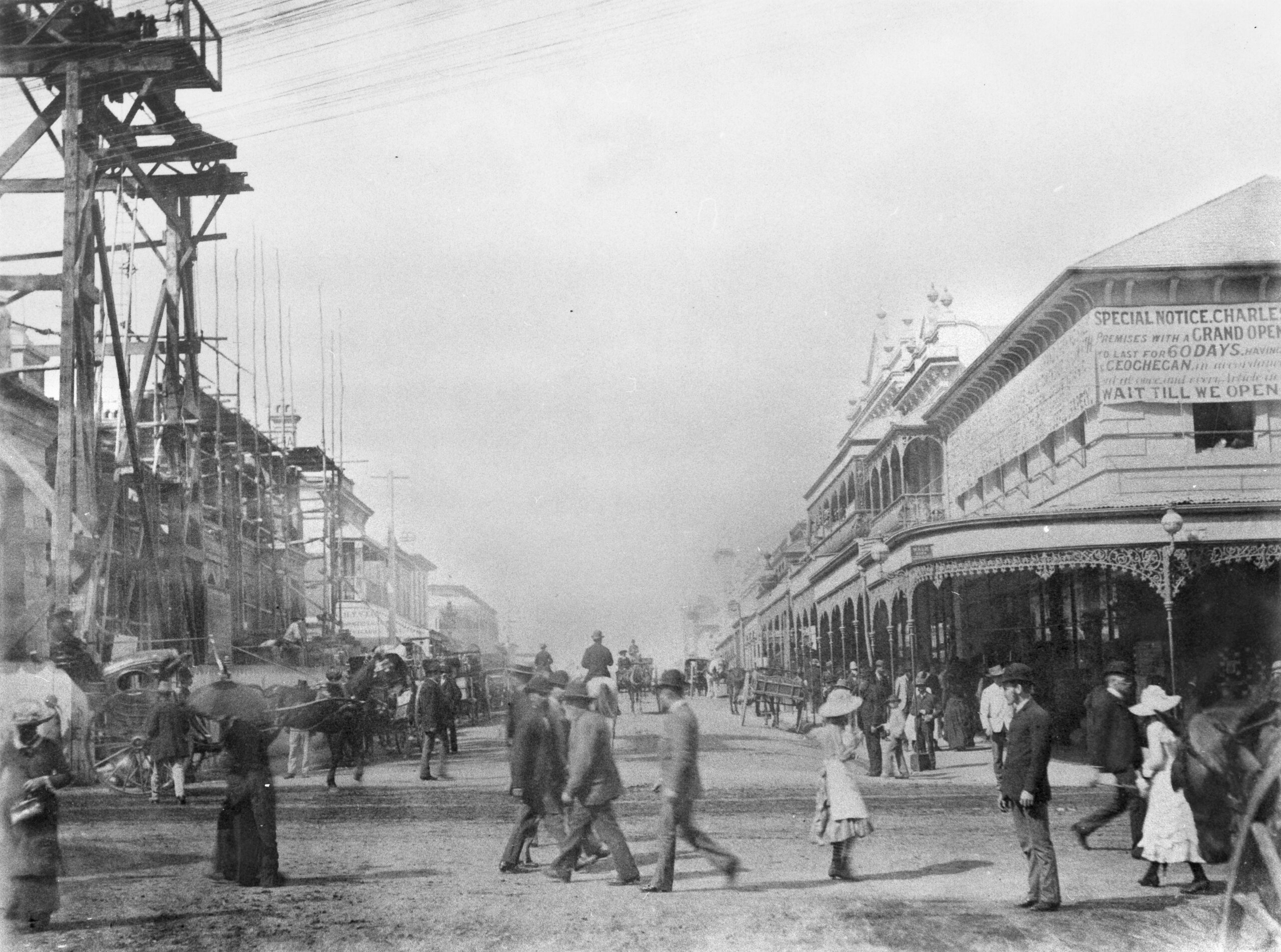
How do we tell the stories of women who ran businesses in the nineteenth and early twentieth century? The ideal of a stay-at-home wife who remains out of the public eye and eschews economic activity is one with which we have been made familiar. But women of all classes throughout history, including in this period, regularly needed to earn an income to support themselves and their families. Many were driving forces behind commercial endeavours both large and small in Australia and globally.[1]
An Occupation for a Lady: Businesswomen in Brisbane’s Arcades, 1880s-1920s delves into the lives of businesswomen in nineteenth and early twentieth-century Queensland at a particular site of business and leisure – the arcade. Often imagined as feminine spaces for women to gather and shop, men are envisaged as the buildings’ owners and business proprietors. But women can regularly be discovered in the arcades operating businesses in their own names or contributing significantly to ostensibly male-run enterprises.
This site presents case studies of some of the businesswomen at Brisbane’s Grand Arcade on the corner of Queen and Edward streets in Brisbane between the mid-1880s to mid-1920s. It takes a biographical approach, exploring three women’s stories before and after their time there, in order to understand why they began and how they ran their businesses, and where their life journeys took them. While these women had diverse origins and backgrounds, their stories show commonalities of experience, motivations and agency, and reveal a fresh but complex story of Brisbane business owners in this period.
For more on these women, their lives and businesses, see Nicole J Davis, ‘An Occupation for a Lady: Businesswomen in Brisbane’s Arcades, 1880s–1920s’, Asia-Pacific Economic History Review (2026). DOI: https://doi.org/10.1111/aehr.70018.
[1] Jennifer Aston & Catherine Bishop, ‘Discovering a Global Perspective’, in Bishop, C. & Aston, J. (eds.), Female Entrepreneurs in the Long Nineteenth Century: A Global Perspective (Palgrave MacMillan, 2020); Leanore Davidoff & Catherine Hall, Family Fortunes: Men and Women of the English Middle Class 1780–1850, 3rd edition (Routledge, 2018).

Nicole J Davis is an urban historian working in the museum and heritage sector. Her research interests centre on urban history and heritage, with a particular focus on Australian urban spaces and their connections to the wider world. She has a Masters in Museum Studies from theUniversity of Sydney, has worked in Sydney and Melbourne museums, and taught in history, heritage and museum studies. Her PhD thesis at the University of Melbourne examined the history and heritage of nineteenth-century Australian arcades from a transnational perspective. Nicole’s latest co-authored book is The Story of Melbourne’s Lanes: Essential but Unplanned, which includes stories of the city’s arcades.
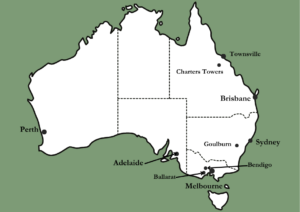
Influenced by European and British precursors, arcades were eagerly adopted as retail and leisure sites in Australia, with over 30 constructed across the continent during the second half of the nineteenth century. The first was the 1853 Queen’s Arcade on Lonsdale Street, Melbourne, while Townsville’s Town Hall Arcade, opened in 1901, was the last of that era. These interior promenades, lined with shops and lit from above by glass, offered a distinctive shopping and leisure experience, which promised (but did not always deliver) a space removed from the discomforts of the outside streets. In Queensland four were built during this period:
- Royal Exhibition Arcade, Queen Street, Brisbane (1877)
- Grand Arcade, Queen Street, Brisbane (1885)
- Royal Arcade (today the Stock Exchange Arcade), Charters Towers (1888)
- Town Hall Arcade, Townsville (1901)
Arcades remained a popular choice for commercial structures up to the present day, although their designs changed markedly over that time, the elaborate details and exuberant designs of the nineteenth-century examples morphing into the cleanlines and uncomplicated styles of the early twentieth century. These buildings continue to exert a fascination for the public – a combination of nostalgia for the past and interest in conserving heritage spaces making them still-attractive leisure destinations.
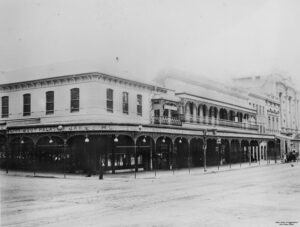
The Grand Arcade, part of a commercial complex named Morwitch’s Minories, was located at the heart of Brisbane’s shopping district, on the southwest corner of Queen and Edward Streets. It was named for the Minories, both a street and district in London’s Whitechapel. The area was home to a working-class population, as well as a large Jewish community, once the home of the Brisbane Minories’ owners, Henry and Sophia Morwitch. In 1854 Henry, a Jewish migrant from Kraków via Bristol in his mid-20s, was trading as a jeweller and silversmith and living in Duke Street, though he would soon leave for Ballarat and the Australian goldfields. Around the corner, Sophia was 14 years old, living in the house of her cloth seller father. It would be a decade before her own departure for the Antipodes and their marriage in New Zealand, though it is not unlikely that at least her father knew the young tradesman in London.
Over twenty years later, they had settled in Brisbane and invested wisely in property on what became some of the most valuable land in the city. Morwitch’s Minories was built on several allotments on the corner of Edward and Queens streets, around the core of a series of earlier structures that had originally housed Southerdens, one of Brisbane’s earliest drapers. In the late 1870s Morwitch refurbished the 1860s corner building to lease for retail and office spaces. Adjacent to this in 1885 he developed the Grand Arcade, a shop-lined interiorised pedestrian promenade that skirted the corner building at a ninety-degree angle, joining Queen and Edward streets.[1] This was not the first arcade the Morwitchs developed in Brisbane: in 1877 they had opened the Royal Exhibition Arcade just a few doors to the east on Queen Street. It had limited success as an arcade but would continue for many years as a retail venture.
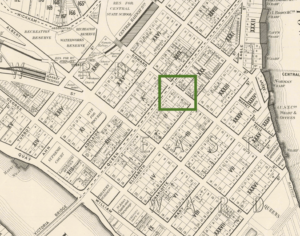
Opening to great fanfare at the end of 1885, the Grand Arcade and the associated Minories buildings together had over 60 lettable spaces, with 56 in the arcade itself. In the 1887 Queensland Post Office directory, the first year it appears, 48 businesspeople are listed the ground floor shops and upper storey office spaces. Of these, only three are specified as women, and each ran very different businesses: Miss Rome, a milliner, at shop 51, hairdresser & tobacconist Mrs Pollock at 50 and in an upstairs office, Mrs Blenkinsop’s servant’s registry. The many other establishments in the building, of which men were named as proprietors, included a tailor, draper, jeweller, engraver, chemist, fancy goods store, fruiterer, tailor, restaurant, architect, theatrical agent, importer, and accountant. In 1888, the rents for these tenancies were advertised as beginning at 25 shillings per week for the shops and from seven shillings and sixpence for the upstairs offices. By 1923, just before the arcade’s closure, the offices were advertised starting at 10 shillings per week.
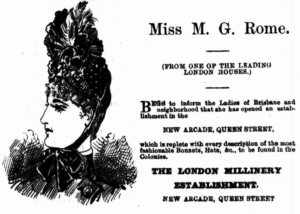
A similar mix of businesses continued here into the early twentieth century. The percentage of women-run businesses seems to have remained relatively small, with between one and seven listed each year. Some ran retail shops and tearooms, but the majority were of other sorts. In 1904, of four women listed, two were palmists, one ran a refreshment room, and the other a servants’ registry. In 1919–1920, the year with the most women listed (seven), there were only two retail stores: a milliner and dressmaker, while the others included a music teacher, a residential agency, and two nurses’ bureaus. This is in stark contrast to the Brisbane Arcade, further up Queen Street when it opened four years later. Of the 52 businesses listed in the 1924–25 directory, women ran 15 to 20.[2]
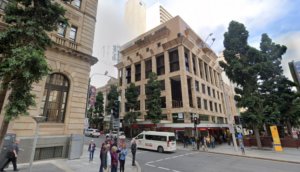
The Grand Arcade and Morwitch’s Minories was modified and demolished gradually between the 1890s and the mid-1940s. The mid-1920s saw the redevelopment of the Grand Arcade’s Edward Street site. Bought by the Tattersalls Club, the old arcade was demolished, an up-to-date building replacing it, with grand club rooms upstairs. On the ground floor, though, Tattersalls invested in retail, with the construction of a new arcade, and used the rents of the doomed Grand Arcade to estimate possible returns. Two decades later, the Queen Street wing of the old arcade buildings had also been replaced by a new wing of the Tattersalls Arcade, once again joining up with the Elizabeth Street wing. Today, much like in 1885, the entire corner block is part of a multi-building complex that forms Tattersalls, with its arcade sitting on the same footprint as the original Grand Arcade.[3]
[1] For an overview of this complex’s development, see John W East, Queen Street, 1900: A Study of the Victorian Architecture of Brisbane’s Principal Thoroughfare (John W East, 2020). The Morwitchs’ life is explored in Nicole Davis, ‘Transnationalism, the Urban & Migration in the Victorian Era: The Lives of Henry & Sophia Morwitch., in Marie Ruiz (ed.), International Migrations in the Victorian Era (Brill, 2016), 156–186. DOI: 10.1163/9789004366398_008
[2] The English Cricketers, Telegraph, 13 March 1886, 4; Brisbane Courier, 27 October 1888, 8; 16 October 1923, 20. Watson’s Post Office Directory, Hollander’s Post Office Directory, Wise’s Post Office Directory, Wetherill’s Post Office Directory, Pugh’s Almanac and Queensland Directory.
[3] Telegraph, 31 May 1941, 9; John W East, Upwardly Mobile in a Branch-Office City: An Architectural History of the Early Skyscrapers of Brisbane, 1911–1938 (John W East, 2018); East, 2020; John W East, Queen Street, 1901–1941: A Catalogue of Buildings Erected in Brisbane’s Main Thoroughfare from Federation to the Second World War (John W East, 2021).
Women business owners have recently become a growing area of historical interest in Australia and globally. Such work frequently employs methodologies that require a more attentive reading of silences and against-the-grain interpretations than is typical in economic history, but it demonstrates that these approaches reveal the presence of businesswomen everywhere. This scholarship has shown that men were not always the minds and money behind commercial endeavours. While nineteenth and early twentieth-century women might often be imagined as existing within domestic sphere, they were regularly involved in a diversity of businesses, large and small. These ventures ranged from less obvious contributions, such as making behind-the-scenes contributions in family firms to operating businesses in their own names where advertising and shopfronts rendered them highly visible in the public sphere.[1]
Tracing the lives of women business owners in Queensland’s arcades from the 1880s to 1920s, this project utilises biography as a method to explore business history and how life events influenced women’s entrepreneurship. This combines with a strong spatial component, examining Queensland businesswomen at a particular type of urban site – the arcade. This site-specific approach provides a bounded space which allows for a comparative examination of the women that ran businesses within – their activities, motivations, experiences and agency. Such a view leads to a more nuanced understanding of public, urban and business history, where the individual story might have capacity to affect our perspectives of the past.
The examination of these lives has methodological value and demonstrates both the difficulties and rewards of researching and telling such stories. The challenges of doing women’s history, which require reading into silences and utilising alternate sources, are heightened when it comes to business history, where women’s involvement is often veiled. Legal strictures might prevent women from owning property or their husbands or fathers controlled their access to and disposal of wealth.[2] Commonplace too is the disguising of women’s business ownership behind men’s names or the recording of only first initials rather than full names in sources. The systematic silencing of women’s participation in these histories compels us to look beyond traditional economic history sources and approaches, and challenge prosaic understandings of women in business.
Business history in Queensland of this period is also challenging due to record survival, perhaps creating even greater silences for businesswomen’s history than usual. Key tools such as business records and registrations, directories, censuses and land titles are missing or incomplete. The 1925 amalgamation of Brisbane’s individual municipal bodies into one council saw the loss of those records that are so valuable for tracing historic buildings, businesses, and their owners and tenants – the municipal rates books. The sewerage and fire insurance maps that give such rich detail about buildings and their occupiers in many cities do not exist for Brisbane until well into the twentieth century. Post Office Directories, as well as newspapers, provide better information and, in many years, give us some understanding of the tenants in Brisbane’s arcades but should be used cautiously as they have pitfalls for compilation of accurate statistical analysis.[3]
In the colonial context we also regularly must search globally for our evidence. This project necessitated research in Brisbane, Queensland, interstate and international archives to begin to tell the stories of around a dozen women who owned businesses in the Brisbane arcades. This was only possible due to the richness of online sources such as digitised archives, cultural collections metadata, family history research and more.
The lives of six have been traced in greater detail, while the three case studies featured here have the most rounded biographies. Each owned businesses in Brisbane’s Grand Arcade during the 1880s to 1920s for different lengths of time and at different points in the period. Their transnational lifeways also reveal global events and movements framed within a local context. All migrated from and made their way to Australia with or to join family members. Two did not remain in Australia and became return migrants to Britain – one after only four and the other after fifty years in the Antipodes – while the other remained for the rest of her life.
Despite their very different backgrounds and diverse future trajectories, this intersection in one place reveals synergies in their life experiences and apparent motivations for running businesses. While their ventures were quite different, the key drivers behind them have similarities: for each, a male relatives’ actions (or inaction) was a motivating element. Such push factors should not detract from their own agency or desire to succeed in their occupations; each likely had a more complex impetus for entrepreneurial activity. Arguably the motivations and actions of individual actors is as vital to understanding business history as overarching economic concerns or drivers – the micro as vital as the macro.
Despite this in-depth research, there are still multiple gaps in these women’s experiences, not least in our understanding of the daily running of their businesses, the economic frameworks in which they operate and their trade networks. Most did not discuss their own business involvement at all, and this can largely only be seen through the lens of third parties.
Gaps notwithstanding, this pilot study has rich promise for future work into women business owners, in the arcades, Brisbane, Australia, and beyond.
[1] E.g., Jennifer Aston, Female Entrepreneurship in Nineteenth-Century England (Palgrave, 2016); Catherine Bishop, Minding Her Own Business: Colonial Businesswomen in Sydney (NewSouth, 2015); Wendy Gamber, ‘A Gendered Enterprise: Placing Nineteenth-Century Businesswomen in History’, The Business History Review 72(2) (1998): 188–218; Alison Kay, The Foundations of Female Entrepreneurship: Enterprise, Home and Household in London, c. 1800–1870 (Routledge, 2009); Tiana Killoran, ‘Sex, Soap and Silk: Japanese Businesswomen in North Queensland, 1887–1941’, Lilith 28 (2022): 35–54, DOI: 10.3316/informit.854502393871708; Claire EF Wright, ‘Gendered Enterprise: Women and Australian Business History’, Asia-Pacific Economic History Review 64(3) (2024): 281–290, DOI: 10.1111/aehr.12303.
[2] Bishop, 2015; Carrie van Lieshout, Harry Smith, Piero Montebruno & Robert J Bennett, ‘Female Entrepreneurship: Business, Marriage and Motherhood in England and Wales, 1851–1911’, Social History 44(4) (2019): 440–468, DOI: 10.1080/03071022.2019.1656929.
[3] Catherine Bishop, Jennifer Aston & Carrie van Lieshout, ‘Bringing Businesswomen to a Count’, Australian Historical Studies 52(2) (2021): 227–246, DOI: 10.1080/1031461X.2020.1833950.
Mrs. Morwitch … was a capable and industrious housewife, paying due regard and deference to her illustrious lord. She was always pleasant and neighbourly.[1]
Sophia, the wife of Grand Arcade’s ostensible owner, Henry Morwitch, demonstrates how concealed the evidence for women’s involvement in business can be. Henry was always described in newspapers as the Brisbane arcades’ owner, suggesting he was the brains and money behind them. Advertising extolled his worth as a good citizen and connected Queensland’s progress as a colony with his building projects and involvement in the lucrative boot and shoe trade. Articles sometimes gave snippets about his wife, like so many women, only described in terms of her qualities in this role. Her involvement in business is only revealed through chance encounters and deep dives into the archives.
Sophia Lazarus was born to a Jewish merchant family in about late 1840 or early 1841 in the City of London, near the Minories in Whitechapel, and died in Brighton, Sussex, UK, on 20 February 1933. Her story is a patchwork, decipherable largely through online family history records, British censuses, death certificates, and information provided by family historians.[2] She first crossed the ocean in her early twenties settling in her uncle’s house in Dunedin, New Zealand, where she married Henry on 23 March 1864. The couple immediately moved south to the goldfields of Tokomairiro, where Henry operated several businesses, including the Great Britain Hotel and concert room. Their time there was short: by August, Henry was bankrupt and taken to court by his debtors, likely precipitating their move to Brisbane where they reappeared the year.[3]
Despite her public characterisation in most newspaper reports, a few small clues in the press reveal her role in businesses credited to Henry. In an 1867 Brisbane perjury case, Sophia’s physical presence in Henry’s pawnbrokers on Albert Street is mentioned several times, including ‘inside the counter’. When advertising for servants in the 1880s and 1890s, applicants are directed to Sophia either in the Grand Arcade office or the boot shop. Her advertisements for workers of differing types possibly indicate that she was running an employment agency as well as watching the boot shot and arcade office. If her activities in 1860s New Zealand are anything to go by, her meaningful involvement in these businesses is highly likely.[4]
Sophia’s business contributions are further revealed if we look a little deeper. Henry’s 1864 insolvency case is preserved in the archive; it not only details his debtors and records his oral testimony but also discusses Sophia’s role in the business. Henry reveals she kept the expenditure books, wrote down the takings she took over the bar, and sometimes paid staff wages. She is regularly mentioned throughout these documents, although Henry downplays her financial contribution, emphasising he has no claim on her money and personal belongings. This implies an attempt to prevent her money or property being sold to pay his debtors.[5] But, arriving in Brisbane later that year, Henry immediately set up another business, perhaps suggesting its financial backing came from Sophia, or that his money was transferred into her name, a common strategy to avoid debtors.
The couple went from strength to strength from that moment and became wealthy land and business owners. After 30 years in Brisbane, they moved to Sydney in 1896, where they again invested in property. They purchased the King’s Arms Hotel, on the corner of Pitt and King Street, the city’s shopping and entertainment epicentre. Seven years later they returned to London, almost 50 years after leaving, and Sophia inherited the hotel after Henry’s death in 1907. She later moved south to the Brighton seaside, where she lived until dying a wealthy woman in 1933. Her probate reveals she left an estate of £90,000, including the hotel, worth around £70,000. Her will, which left the bulk to the Brighton Jewish Synagogue, was contested by her nephew in the Sydney courts between 1934 and 1937, claiming influence by Sophia’s maid, who received £6,000. One niece testified Sophia was a bitter, senile woman living in filth, while the man who wrote her will said she was ‘a sprightly, well-preserved old lady … a most clear-minded … very intelligent woman’.[6]
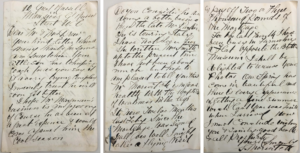
A series of letters written by Sophia from London and Brighton to her Sydney solicitor were also presented to show her state of mind. In them she gives instructions for the management of the Sydney property both before and after her husband’s death and discusses the licensees of the hotel and their prospects in detail, suggesting Sophia knew how to manage her assets and maintained a keen interest in their operation. While Henry was the public face of both the couple’s financial achievements and catastrophes, the evidence shows that she worked in and materially contributed to their businesses. Given Henry’s repeated bankruptcies prior to his marriage and the unfailing successes following it, we are left to conjecture that Sophia’s contributions may have been significant.[7]
[1] Brisbane Courier, 26 November 1921, 14.
[2] Scott Morwitch, ancestor of Henry Morwitch’s brother, has been invaluable to my studies of Henry and Sophia Morwitch.
[3] Otago Daily Times, 6 April 1864, 4; 7 April 1864, 7; Lyttelton Times, 28 May 1864, 5; Bruce Herald, 5 January 1865, 4.
[4] Telegraph, 2 March 1888, 1; Brisbane Courier, 18 May 1894, 6.
[5] MORWITCH Henry – Tokomairiro – Storekeeper, 1864, Te Rua Mahara o te Kawanatanga Archives New Zealand, DAAC D256 20364, Box 617.
[6] Sun, 17 May 1937, 1.
[7] Sophia Morwitch – Date of Death 20/02/1933, Granted on 18/06/1934 [Probate (Letters Packet)], Museums of History NSW, NRS-13660-15-1812-Series 4_196633.
Miss Rome, a young lady whose experience … has been acquired in one of the best London houses, has opened a millinery establishment in the Grand Arcade … with a very choice assortment of … hats and bonnets.[1]
One of the Morwitchs’ first tenants in the Grand Arcade was Miss Gertrude Rome’s London Millinery Establishment. In contrast to her landlady, its proprietor appeared to be an independent entrepreneur. At no time was her business associated with any male relatives and she was fully acknowledged as the owner and the brains behind the establishment in the advertisements and articles that ran regularly in Queensland Figaro & Punch from 1886 to 1887. One relates that she sold up-to-date fashions in the colonies, including those popular in London and Paris, while another claims some of her stock is sourced directly from London.[2]
These are all common refrains in Australian advertising, which equates the commodities available in Australian colonial towns and cities with those of Britain and Europe (but also other international locations). Some may have been imported from there, while others are colonial made but, of course, in the latest styles. This emphasis on connections to stylish, refined and cosmopolitan locations and lifestyles demonstrates a claim to sophistication and civilisation in the colonial Australian landscape, a characterisation we see repeatedly in discussions of the arcades themselves.[3]
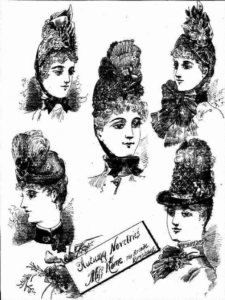
Gertrude was born in Maghull near Liverpool, in 1867 to cotton broker Thomas Rome and Marie Catherine Rome (née Bleakman). The growing family are recorded there at Claremont House in the 1871 census but by 1881, Catherine is recorded living apart from her husband with her three children, Edward, Gertrude, and Percy, in the nascent suburb of Balsall Heath near Birmingham. Thomas appears to have moved to Scotland before or soon after, dying in Aberdeen in October 1886. By this time, his family were living on the other side of the world in Brisbane, Australia. They had arrived on 22 July 1885 on the Cloncurry from London. Although we cannot know for certain what prompted this journey, her father’s bankruptcy, possible mental health issues and likely abandonment of the family could have been significant factors.[4]
We do know that Gertrude’s business was likely operational five months later when the Grand Arcade opened in December 1885, operating throughout 1886 according to newspapers. In early 1887 Miss Rome moved out of the arcade for larger premises nearby on Edward Street, seemingly heading for bigger and better things. But she soon disappears – her last newspaper advertisement appears in June 1887. After this, we receive only hints for the next few years. She may be the Miss Rome who, along with a Miss Cullen, ran The Ladies’ Typewriting Association on Eagle Street by 1889 and is possibly the Gertrude Rome who offered land for sale to the Coorparoo Council in 1890. We do hear of her other family members in newspapers, an inquest and a death certificate. On 15 December 1889 her 13-year-old brother, Percy, drowned while swimming with his brother, Edward, in the Brisbane River near their home at Indooroopilly. The brothers and their mother are discussed in documents surrounding his death, but of Gertrude there is no mention.[5]
Gertrude and Catherine are possibly the Mrs and Miss Rome that left Sydney on the Orizaba in mid-1890. They certainly reappear in Britain several years later – Catherine remarried in 1893 and Gertrude wed Alfred Knoop the following year in Coventry. Gertrude afterwards appears in archival snippets until her death in 1951 but she is most visible in her turn-of the century novels, published under the pseudonym Perrington Primm. At the start of The Girl at Riverfield Manor (1900), her English immigrant protagonist, Irene, is living at Indooroopilly but preparing to depart for England.
The author describes in detail Irene’s home, the layout of Brisbane, her sensory experiences, sympathy with the dispossession suffered by Indigenous Australians, and the devastating loss of her father just prior to Christmas. Irene departs Australia but later returns on the Orizaba for the end of the novel.[6] It is not certain, but likely, that Gertrude drew on her own time living there, giving us a sense of her life experiences, although she is silent about her time as a business owner. While we can only speculate at the drivers for Gertrude Rome’s migrations and business venture in Brisbane, family events seem likely to be a factor. Despite this, we hear her voice through her writing and her experiences of Australia, albeit far removed from those of a businesswoman.
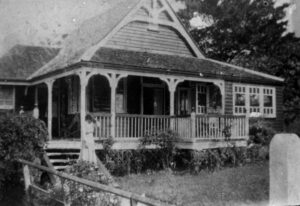
[1] Queensland Figaro & Punch, 23 January 1886, 34.
[2] Ibid.; Queensland Figaro & Punch, 6 February 1886, 5, 8 May 1886, 20; 26 February 1887, 1; 16 April 1887, 5.
[3] Nicole J Davis, ‘Nineteenth-Century Arcades in Australia: History, Heritage & Representation’, PhD Thesis, University of Melbourne, 2023, Chapter 4; Nicole J Davis, ‘“One of the Sights of the Colony”: Australia’s Nineteenth-Century Arcades’, History of Retailing & Consumption 9 (2023): 255–275, DOI: 10.1080/2373518X.2023.2295668.
[4] 1871 England Census, PRO RG105870; 1881 England Census, PRO RG11/2947, Ancestry; Liverpool Weekly Mercury, 16 March 1872; Commissioners in Lunacy, Entry for Thomas Rome, line 90547, 1874, Lunacy Patients Admission Registers, The National Archives, Kew, England, Series MH 94; Piece: 2; General Register Office for Scotland, Statutory Registers – Deaths, Entry for Rome, Thomas, 168/1 904, District of St Nicholas, Borough of Aberdeen, 3 November 1886, 302, Scotland’s People; Immigration Department [Qld], ‘Register of Passengers on Immigrant Ships Arriving in Queensland – No. 7’, Cloncurry, arrival in Brisbane, 7 January 1885, Queensland State Archives, ITM18482.
[5] Department of Justice, ROME Percy [Inquest File], 1889, Queensland State Archives, ITM2730128; Brisbane Courier, 17 December 1889, 4; Moreton Mail, 20 December 1889, 7; Darling Downs Gazette, 18 December 1889, 3; Inward Passenger Lists, ‘Inward Passenger Lists (Australian Ports)’, 13 October 1890, Orizaba, Public Record Office Victoria, VPRS 944/P0 Box 70, 162.
[6] Perrington Primm [Gertrude Knoop], The Girl at Riverfield Manor (FV White & Co., 1900); Ivy Cardew (Jarrold & Sons, 1901).
Madame De Grevell, spiritual trance medium, Xray clairvoyante: hours, 10.30 a.m. —10 p.m. 12 Arcade, Edward street.[1]
Anna Helmenia Mikalsen was born on 4 April 1863 in the Hammarøy district in northern Norway. The 22-year-old departed her homeland in 1885 during a period of mass Scandinavian migration. Unlike many, her destination was not the United States but Queensland, Australia. En route, during a ten-day stop in London, she married fellow Norwegian Henrik Marcelius Mikalsen in Whitechapel. Queensland was an attractive prospect for Scandinavian immigrants, with promises of high wages and land.[2]
They lived first at North Pine District near Brisbane, where son Harry was born in January 1887.[3] The next year they moved north to Glass House Mountains, where Crown Land was on offer to settlers, a period of intensifying occupation that greatly impacted the Kabi Kabi (or Gubbi Gubbi) and Dalla (Jinibara) people.[4] Henrik selected farmland at the foot of Mt Coonowrin. They cleared bushland, fenced the property, built a house, and planted a fruit orchard, which they worked for two decades, having six more children – the youngest, Norman, born in 1898.[5]
Just over a decade later, Henrik left, returning to Europe, where he started a new family. Anna’s letters, written in the 1920s, suggest that her husband leaving had a significant financial impact. Although she ran the property for a few more years, in 1911 she sold up and was living in Brisbane by 1913. In January the next year, newspaper classifieds show that she had turned to another profession to earn an income, one not uncommon for women in her situation.[6]
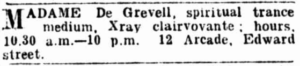
Anna Mikalsen became Madame de Grevell, advertising in Brisbane newspapers as a ‘Trance Medium, Clairvoyant, Palmist’.[7] As Alana Piper has explored, the early years of the twentieth century were a period of increasing interest in spiritualism and its related practices. Fetes, garden parties, balls, and local shows often featured fortune-tellers as a fun diversion. But it was also an occupation regularly advertised in the newspapers, often run by women, and became increasingly professionalised in the period.[8]
Many in the profession rented offices in commercial buildings, including Madame de Grevell’s upstairs in the Grand Arcade. Most late nineteenth-century arcades were designed not simply as retail ventures but also supplied commercial spaces to a wide variety of businesses. They were not unusual locations for those providing such services and advertisements show clairvoyants operating in similar sites across Australia. Mikalsen was also not the only clairvoyant in the Grand Arcade; over the years others like Sister Alrene, Madame Mora, and Madame St Aubyn, operated out of the arcade.[9]
Madame de Grevell appeared regularly in the Brisbane papers, sometimes daily during the period 1914 to mid-1916. Labelled by others as ‘fortune-tellers’, like most fellow practitioners, she rejected this term, and styled herself a trance medium, palmist, and clairvoyant, among other terms. She worked long hours: one advertisement showed her availability from 10am to 10pm, except on Tuesdays and Fridays when she worked ten to six. Fortune-tellers with regular clientele could earn a steady income, and the work was very lucrative for some.[10]
Although this was an era of professionalisation for these businesses, it also saw increasing policing, legislation and prosecution. Backlash against female fortune-tellers arose for a variety of reasons, including fears of their influence over middle-class and elite women, as well as disgruntlement that working-class women could make good money from it. During World War One, a period at which we see a peak in the profession, public concern and criticism often arose about fortune-tellers taking advantage of those who feared for loved ones posted overseas.[11]
Despite their everyday office spaces, the same papers that accepted their fees for short classifieds were keen to sensationalise and demonise these businesspeople. In 1904 Madame Spontini and Madame Mora of the Grand Arcade featured in an article, ‘Fortune Telling Frauds’, which described their rooms and practices in lurid language. In-depth investigations were also undertaken by Brisbane police during the 1910s and 1920s, which led to prosecutions for Madame Mora and her fellow arcade tenant Madame St Aubyn.[12] Madame de Grevell also appears in these police reports in August 1921 and early 1923 but avoided lengthy investigation or prosecution.[13]
After 35 years living in Australia, Anna Mikalsen applied for naturalisation and a pension in 1921–1922, with a testimonial attesting her ‘excellent character and nothing is recorded that precludes her from the privileges of naturalisation’. No connection was apparently made between her and Madame de Grevell, despite her full legal name appearing in the 1923 police reports.[14]
Although she appears in classifieds advertising her own business until mid-1916, they declined sharply after World War One began, ending in 1919. But she began to regularly feature instead at events at the Brisbane Spiritual Church, where she presented addresses such as ‘Spiritualism Pointing Out the Better Way’ and conducted psychic readings until late 1923.[15]
How, when and why Anna Mikalsen was drawn into the clairvoyant business is not clear. But a set of occurrences that are similar to the life stories of other women who took up the profession resonate with her life. Like Anna, they were often working class and experienced straitened circumstances, as result of their husband’s death or abandonment, or because of age or ill health. In 1921 Anna claimed to have become disabled through an operation but she was also an older woman, turning 51 when Madame de Grevell appeared. As a farmer for most of her adult life, her skillset and employment options were likely narrow.[16]
But these practices may not have been simply a business. In November 1916, the time when her involvement with the Spiritual Church increased, her 18-year-old son, Norman, enlisted and shipped out to England. He was killed two years later near the Somme in August 1918. While we do not know Anna’s thoughts about her business nor her spirituality, like her clients, she perhaps found comfort in the movement and mediumship, providing a connection with deceased loved ones and the promise of an afterlife.[17]
We do know some of her thoughts about her life through her letters attached to Norman’s AIF records and her naturalisation application. The independence Anna Mikalsen insisted on in her personal letters and dealings with the authorities demonstrates a determination to support herself and her children but also that she would not be dealt with on terms related to her husband.
In one she made clear she was the family’s provider; particularly when the military tried to preference her husband as recipient of Norman’s war medals. She wrote:
I do not know whether [Henrik] is living or dead, he has not been heard of since 1909. I have had no communication nor do I know vere [sic] he is, only, he left Australia in that year for foreign lands, ‘Europe most likely’, and have never been heard of since he is no more to us, he left the children and my selfe with out support, “I” gave my son for the country this all I can say.[18]
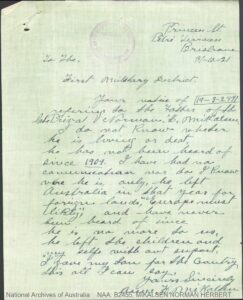
When Government officials tried to deny her naturalisation on grounds of being a married woman, Anna again wrote in the strongest terms about her abandonment and an official pencilled in the remark, ‘treat as widow’. Her citizenship was issued on 29 December 1921.
On 25 August 1923 Anna Mikalsen and her family placed a memorial for Norman in the Daily Standard. Six days later Madame de Grevell last appeared in an advertisement in the same paper for a talk at the Spiritual Church, ‘The Robes of Immortality’. She died on 20 September 1923 of a cerebral haemorrhage. Unusually, her still-sealed intestacy file, as well as associated Public Curator newspaper notices, are labelled with both her legal name – ‘Anna Helmenia Mikalsen’ – and her professional one – ‘Madame de Grevell’. Likewise, soon after death, Anna Mikalsen was memorialised by her family in the newspapers, as well as on her tombstone, by both her names, suggesting that for them and her, these two lives were inextricably connected.[19]
[1] Telegraph, 8 January 1915, 9.
[2] Department of Home and Territories, Central Office, ‘Mrs A.H. Anna Helmina – Naturalization’, 1921–1922, National Archives of Australia, A1; 1921/18684; General Register Office, England and Wales Civil Registration Marriage Indexes; entry for Mikalsen, Henrik, Vol 1c, Registration District, Whitechapel, Oct– Nov–Dec 1885, 187, England & Wales, Civil Registration Marriage Index, 1837–1915, Ancestry; Queensland Births Deaths & Marriages [henceforth, Qld BDM], 1923/B/40994; Frederik Larsen Lund, ‘A Norwegian Waltz: Norwegian Immigration and Settlement in Queensland 1870–1914’, MA Thesis, University of Oslo, 2012.
[3] Qld BDM, 1887/C/1043; ‘Mrs A.H. Anna Helmina Mikalsen’, 4.
[4] Chronicle and North Coast Advertiser, 26 March 1915, 4; Lands Department, ‘MIKALSEN, Henrik Marcelius’ [land selection file], 1888–1894, 26, Queensland State Archives, ITM2797333; ‘Glass House Mountains National Park: Nature, Culture, and History’, Queensland Government: Department of the Environment, Tourism, Science and Innovation; ‘National Heritage Places – Glass House Mountains National Landscape’, Australian Government: Department of Climate Change, Energy, the Environment and Water.
[5] Two, Peter and Oschar, died in childhood. Anna Helmenia (Anna Hilda) Mikalsen nee Peterson, Ancestry; Qld BDM: 1889/C/1338; 1890/C/1729; 1890/C/689; 1892/C/1911; 1894/C/1405; 1894/C/628; 1896/C/1428; 1899/C/1355; Australian Electoral Rolls 1903–1980, Beerwah, 1903, 1905, 1908, Ancestry; Supreme Court, Southern District, Brisbane, Oath of allegiance, Henrik Mikalsen, Butts of Oaths of Allegiance Sworn by Aliens Being Naturalised, 1888, 29, Queensland State Archives, ITM882269; Sydney Morning Herald, 11 January 1886, 8.
[6] Brisbane Courier, 9 December 1911, 8; Telegraph, 26 September 1913, 15; Australian Electoral Rolls 1903–1980, Beerwah, 1909, 1913; Brisbane North, 1913, 1916; Anna H Mikalsen to the First Military District, 31 June 1921. In Australian Imperial Force, Base Records Office, ‘MIKALSEN Norman Herbert: Service Number – 7028: Place of Birth – Glass House Mountains QLD: Place of Enlistment – Brisbane QLD: Next of Kin – (Mother) MIKALSEN Anna’, 1914–1921, National Archives of Australia, B2455, MIKALSEN NORMAN HERBERT.
[7] Telegraph, 27 January 1914, 11. The spelling on her intestacy record and death notices is ‘de Grevelle’ and on her tombstone, ‘de Greville’, but in newspapers usually ‘de Grevell’.
[8] Alana Piper, ‘Women’s Work: The Professionalisation and Policing of Fortune-Telling in Australia, Labour History 108 (2015): 37–52, DOI: 10.5263/labourhistory.108.0037.
[9] Telegraph, 12 December 1914, 5; 24 December 1914, 8.
[10] Tamson Pietsch, interviewing Alana Piper, ‘Making a Fortune’, History Lab, season 3, episode 2, University of Technology Sydney, 2019; Piper, 2015; Alana Piper, ‘“A Menace and An Evil”: Fortune-Telling in Australia, 1900–1918, History Australia 11(3) (2014): 53–73, DOI: 10.1080/14490854.2014.11668531; Alana Piper, ‘Did They See It Coming? How Fortune-Telling Took Hold in Australia –With Women as Clients and Criminals’, Conversation, 4 February 2020; Samadhi Driscoll, ‘Fortune-Telling, Family History and Feminism’, VIDA, 7 September 2016.
[11] Pietsch and Piper, 2019; Piper, 2015.
[12] Truth, 14 February 1904, 7; 21 February 1904, 7; 14 October 1917, 5; Telegraph, 11 October 1917, 7; T Power, ‘Relative to J.J. Maxwell, and Madame St-Aubyn, Clairvoyants’, 20 August 1917, in Police Department, Police Service Commissioner’s Office, ‘Palmists, Fortune Tellers, Clairvoyants, Etc.’, 1917–1926; Queensland State Archives, ITM318941; Piper, 2015
[13] Arthur R Norton, ‘Relative to:– the attached newspaper cutting showing a number of advertisements of Clairvoyants who are carrying on that business about Brisbane’, 11 August 1921, FH McIver, ‘Relative to Fortune Tellers, vide attached’, 16 January 1923, both in Police Department, 1917–1926.
[14] AM Short, ‘Report on Application for Naturalization by (Mrs) Anna Helmina MIKALSEN.’, 12 September 1921, in Department of Home and Territories, 1921–1922.
[15] Brisbane Courier, 19 August 1922, 20; 10 February 1923, 20; 1 September 1923, 24; 26 October 1923, 4; Daily Standard, 25 August 1920, 4; 12 December 1923, 7; 23 September 1924, 5; Qld BDM, 1923/B/40994.
[16] Piper, 2015.
[17] Repatriation Commission, ‘Application for pension – Anna H Mikalsen, Deserted Mother of Deceased Soldier’, 1922, National Archives of Australia, A2487, 1922/8040.
[18] Anna Mikalsen, 31 June 1921. Also, Anna Mikalsen, ‘Letter to the Secretary, Home Territories Department’, 17 August 1921, in Australian Imperial Force, Base Records Office, 1914–1921.
[19] Public Curator Office [Queensland], ‘MIKALSEN, Anna Helmenia (GREVELL, Madam de)’, 1923–1983, Queensland State Archives, ITM1500918; Headstone of Anna Mikalsen (Madam de Greville), 1923, Toowong Cemetery, Brisbane, Australia, Find a Grave, Memorial ID: 247580568.
Map
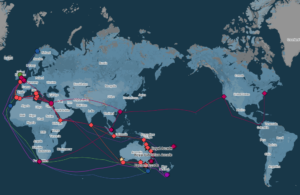
This custom interactive Google map showing the life journeys of Queensland arcades’ businesswomen is currently under development. It has multiple layers, one showing nineteenth-century Australian arcades locations and some of their physical outlines. More photographs and details will be added over time.
The other layers follow the life journeys of Brisbane’s arcade business owners. Currently featured are those of the three women featured as case studies on this project page, as well as two others. Further detail will be added in future, as well as those of other women (and men) who owned arcade businesses.
To use the map, click on the check boxes at the left to turn layers on and off. You can zoom in to see the arcades in different cities or zoom out to see the individual women’s life journey layers – the places might surprise you! Some locations and journeys are approximate.
Journal Articles
Nicole J Davis, An Occupation for a Lady: Businesswomen in Brisbane Arcades, 1880s–1920s. Asia-Pacific Economic History Review (2026). DOI: 10.1111/aehr.70018
Talks
An Occupation for a Lady: Businesswomen in Brisbane’s Arcades, 1880s–1920s. Centre for the History of Retailing and Distribution (CHORD) Online Seminars, 23 February 2026.
Women Business Owners and Australia’s Nineteenth-century Arcades: Local Communities, Global Connections’, Female Entrepreneurship in the Long Nineteenth Century Panel, World Economic History Congress, Lund, Sweden, 29 July 2025.
Occupations for Ladies: Entrepreneurial Women in Brisbane’s Nineteenth-century Arcades. QSA Talks, Queensland State Archives, Brisbane, 27 March 2025.
All the Latest Novelties: Modernity, Luxury and Consumer Desire in Australia’s Nineteenth-Century Arcades. Presented at:
- University of Melbourne, School of Historical and Philosophical Studies, Brown Bag Seminar, 30 April 2026
- Textile and Fashion Group Seminar Series, 8 April 2026
- The Fashion Cycle: From Retail to Reuse, Material Histories Seminar, Old Treasury Building, online, for PayPal Melbourne Fashion Festival, 28 February 2025
Have You Met Miss Rome? Women Businessowners in Brisbane’s Arcades, 1890s to 1920s. Textile and Fashion Group Seminar Series, 2 October 2024
Related Publications & Presentations
Weston Bate, Richard Broome, Nicole J Davis, Andrew J May & Helen Stitt, The Story of Melbourne’s Lanes: Essential but Unplanned (Royal Historical Society of Victoria & State Library Victoria, 2024)
In Arcadia: Finding the Women Owners of Nineteenth-Century Arcades in Australia. RHSV (Royal Historical Society of Victoria)/PHA (Professional Historians Association, Victoria & Tasmania) Symposium: Emerging Historians: The Element of Surprise in Historical Research, 17 October 2023
Nicole Davis, ‘One of the Sights of the Colony’: Australia’s Nineteenth-century Arcades, History of Retailing & Consumption, Special Issue: History of Retail in Australia (2024). DOI: 10.1080/2373518X.2023.2295668
Nicole Davis, Transnationalism, the Urban & Migration in the Victorian Era: The Lives of Henry & Sophia Morwitch, in Marie Ruiz (ed.), International Migrations in the Victorian Era (Brill, 2018). DOI: 10.1163/9789004366398_008
James Lesh & Nicole Davis, Lost [in] Arcadia: Regenerating Melbourne’s nineteenth-century shopping arcades since the 1950s, Remaking Cities. 14th Australasian Urban History/Planning History Conference (UHPH), Melbourne, Australia, Sunday 31 January – Wednesday 3 February 2018 (published online 2018). Peer reviewed. DOI: 10.25916/5c2422666df81
Nicole Davis, Arcadia in Australia: The Nineteenth-Century Shopping Arcade, Icons: 13th Australasian Urban History/Planning History Conference (UHPH) Gold Coast, Queensland Sunday 31 January – Wednesday 3 February 2016 (published online June 2016). Peer reviewed. DOI: 10.25916/5c26bd7523077
Map

